

Cracking Open Curiosity: The Linchpin of a
Capability-Rich Curriculum
by Dan Dempsey, Director of Professional Learning at Future Anything
In today’s blog, Dan Dempsey explores Curiosity as a future-ready capability and shares 10 practical, fast, and fun ways to build it in your classroom.
Have you ever had a student ask a question so unexpected it stopped you in your tracks?
One that sparked thoughtful debate, redirected the discussion, or opened up a new line of inquiry, joyfully taking learning off-script?
This is curiosity in action. And it is powerful.
At Future Anything, we believe that education must extend beyond content delivery. It should focus on equipping young people to navigate and thrive in an increasingly complex world – one where adaptability, creativity, and a sense of purpose is essential.
Enter the Future Anything Capability Framework.
The Future Anything Capability Framework identifies six future-ready capabilities that sit at the heart of our programs and learning design: Curiosity, Creative Thinking, Critical Thinking, Communication, Action, and Agility (you can read more about it here).
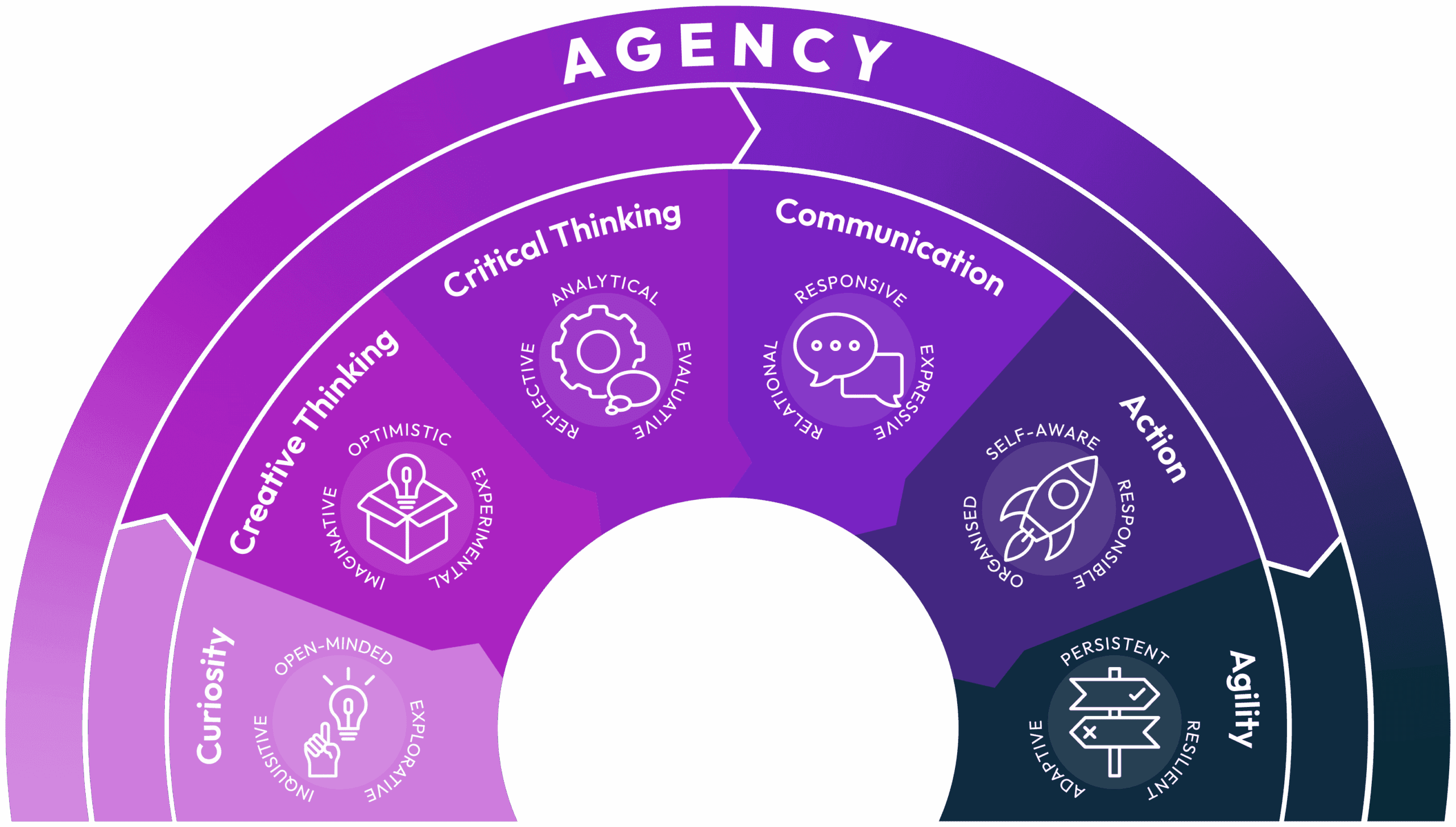
© 2025 Future Anything. All rights reserved.
This framework may be shared for educational purposes with attribution but may not be modified or used commercially without permission.
Rather than treating these capabilities as a ‘bolt-on’ to curriculum objectives, we position them as foundational skills that empower students to embrace the ‘how’, not just the ‘what’.
These capabilities support students in developing meaningful agency – the ability to make informed choices about how they learn, what they create, and how they respond to the world around them. In our work, we advocate that when students are able to wield the six capabilities confidently, that’s when true agency shines.
Where to start?
At the foundation of this work underpinning all of the capabilities is curiosity. After all, if students aren’t interested enough to ask a question, then they aren’t interested. That’s why we see curiosity as the linchpin of engagement – the spark that starts it all.
So, if curiosity is the spark that ignites every other capability, what does it actually look like in practice?
Curiosity can be loud or quiet, showing up in big questions and thoughtful silences. Curiosity looks like:
- Asking questions
- Seeking solutions
- Inquiring
- Problem finding
- Asking “why?”
- A desire to learn
- Seeking to understand others
- Showing interest
- Demonstrating empathy
- Being thoughtful
- Staying open to possibilities… to unravelling “why?”
These actions reflect curiosity as a way of being, not just a one-off behaviour, but a disposition, a habit, and a skill that grows over time.
In this blog, I’ll unpack the research behind curiosity, share practical strategies to build it, and point you to powerful resources that can help you make curiosity the cornerstone of a capability-rich classroom.
Why Curiosity Matters: What Does the Research Say?
The Future Anything Capability Framework draws on foundational research from thinkers such as Engel, Kashdan, and Claxton, who conceptualise curiosity as both a mindset and a teachable skillset.
Kashdan and Fincham (2002) tells us that curiosity is more than momentary interest, it is a self-regulating drive that fuels persistence, exploration, and creative thought by “actively acquiring information to create, maintain, and/or resolve meaningful perceptual conflicts of gaps in knowledge”.
Curiosity energises us to pursue knowledge not just for external reward, but because the search itself is meaningful. It helps us persevere with complex tasks, reframe challenges, and connect previously unrelated ideas. In this way, curiosity becomes a catalyst, not only for personal growth, but for the kind of creative and critical thinking required in dynamic, real-world settings.
Kashdan and Fincham (2002) further state that curiosity appears to be a fundamental motive in facilitating industry and curiosity may be a link between an individual’s experiences and an individual’s creativity skills.
Other key insights from the research include:
- Curiosity is fundamental to children’s development and unfolds through social interactions. Furthermore, schools and policymakers need to prioritize curiosity as a central educational goal, alongside traditional academic skills, to create more engaging and effective learning environments (Engel, 2011)
- Curiosity is the prerequisite for exploring the environment and the self (e.g., ideas, emotions), thus leading to the attainment and integration of novel perspectives and experiences (Kashdan, Rose, & Fincham, 2001)
In short: if we want capability-rich learners, we need to start with curiosity.
Drawing on the research foundation, The Future Anything Capability Framework defines Curiosity as:
“The drive to explore, ask questions, and seek new understanding about the world around us.”
It’s made up of three core competencies (sub-skills):
- Inquisitive: Asking questions to engage in discussions and clarify understanding.
- Open-Minded: Exploring diverse perspectives and challenging assumptions.
- Explorative: Seeking out new knowledge independently, across varied contexts.
The ‘How’: Fun, Fast, Frequent Activities
Now that we know what the research tells us about curiosity, what can the explicit development of this as a capability in the classroom look like in practice?
In our work at Future Anything, we advocate that capabilities can be developed with fast, frequent and fun practice. In fact, our research indicates we can see growth of 5-8% in target capabilities in secondary school students, doubling to 10-16% in primary school students, from simply spending 10 minutes a week for ten weeks on embedding a chosen capability.
This starts with saturating learners with fun and success in a low stakes environment, building complexity and alignment to curriculum over time, with the intention of deepening engagement and enhancing motivation.
In the case of curiosity, well placed ‘inciting incidents’ in the first week of learning are a great way to kick off a new unit, opening up possibility, generating interest, amplifying real-world connection and building relationships and culture.
One tool to help you build out your next inciting incident is the use of Generative AI, using one of our popular AI prompts with your favourite Generative AI platform:
Context: I am a primary/secondary teacher in Year ___ developing a unit about ____.
Ask: I want to build out an inciting incident idea that will inspire curiosity and interest in the first week of learning.
Parameters: Can you provide me 10 inciting incident ideas that will:
– open up possibility
– generate interest and engagement
– amplify a real-world connection.
– build relationships and classroom culture.
10 Practical Activities to Build Curiosity in the Classroom
What could the intentional development of curiosity look like in practice using fast, fun and frequent activities?
Below are ten practical classroom activities that explicitly nurture one or more of the competencies within the capability of curiosity. These can be adapted for primary or secondary contexts.
-
1. Question Relay
Subskill: Inquisitive
Year Levels: Upper Primary – Secondary
Students work in small groups to pass a topic around (e.g. “Artificial Intelligence”) and must only contribute a question – not a statement – each turn. Questions can’t be repeated, and each must build on the last. Debrief by highlighting the quality of questions and follow-up discussions.
-
2. Wonder Walls
Subskill: Inquisitive & Explorative
Year Levels: Primary
A visible space in the classroom where students regularly post questions they have about the world, the unit, or the task. Use sticky notes, Padlets, or whiteboards. Teachers can use these questions to drive inquiry, model curiosity, or structure learning experiences.
-
3. Perspective Maps
Subskill: Open-Minded
Year Levels: Secondary
Students explore an issue (e.g. fast fashion, social media regulation) from different stakeholder perspectives—such as a business owner, environmental activist, teenager, or policymaker. They document how views differ and what assumptions are being made.
-
4. Curiosity Experiments
Subskill: Explorative
Year Levels: Primary – Lower Secondary
Offer a hands-on provocation (e.g. a mystery object or scientific phenomenon) with minimal context. Students generate questions, hypotheses, and design mini-investigations. Perfect for science, HASS, or STEM.
-
5. Curious Correspondence
Subskill: Open-Minded & Inquisitive
Year Levels: Upper Primary – Secondary
Pen-pal or class-to-class projects where students write questions instead of just letters—targeting students from other regions, schools, or countries. Helps develop empathy and builds intercultural understanding through authentic inquiry
-
6. “I used to think… Now I think…”
Subskill: Open-Minded
Year Levels: All
Use this visible thinking routine after watching a video, reading a story, or discussing an issue. Encourages students to reflect on how their understanding has shifted—and rewards changing your mind based on new evidence.
-
7. Curiosity Circles
Subskill: Inquisitive & Explorative
Year Levels: Secondary
Students work in circles to explore big questions, e.g., “What will jobs look like in 2050?” One student asks a question, another builds on it or redirects it. After each round, the group identifies the three most powerful questions to investigate further.
-
8. What’s Going On Inside This Picture?
Subskill: Inquisitive
Year Levels: Primary
A visual literacy warm-up. Display an unusual or ambiguous image. Students must ask questions, not make assumptions. Use sentence starters like “I wonder…” or “Could it be…?” to drive the thinking.
-
9. Passion Quests
Subskill: Explorative
Year Levels: Upper Primary – Secondary
A mini-inquiry where students choose something they’re deeply curious about and explore it through reading, interviews, or creation. Scaffold with checkpoints: What’s your driving question? What are your sources? What did you discover?
-
10. Curiosity Dice
Subskill: All Three
Year Levels: Primary
Create a large dice with question prompts like: “What would happen if…?”, “Why is this important?”, “Who might disagree?”, “Where else could this apply?”, “How can we find out more?” Use in any subject to spark deeper inquiry and discussion.
Want to Dig Deeper? Recommended Resources
Here’s a curated mix of tools, voices, and inspiration to explore curiosity further:
Books
- Curious: The Desire to Know and Why Your Future Depends On It – Ian Leslie
- A More Beautiful Question – Warren Berger
- Creating Cultures of Thinking – Ron Ritchhart
Podcasts
- The Cult of Pedagogy – especially episodes on inquiry-based learning
- The Curious Advantage – focused on curiosity in life and leadership
- Future Anything: Live Learning Series – real educators, real provocations
Websites
Final Thoughts
In a world where every answer is one click away, it’s the questions that matter most.
When we crack open curiosity in our classrooms, we don’t just ignite student engagement – we activate every other capability. We make learning richer, deeper, and more human.
Let’s build capability-rich classrooms.
And let’s start with curiosity.
References
Kashdan, T. B., Rose, P., & Fincham, F. D. (2001). The Curiosity and Exploration Inventory: Theoretical basis and construct validation.
Kashdan, T. B., & Fincham, F. D. (2002). Facilitating Creativity by Regulating Curiosity. American Psychologist, 57(5), 373–374.
Engel, S. (2011). Children’s Need to Know: Curiosity in Schools. Harvard Educational Review, Vol. 81, No. 4, Winter 2011, pp. 625–645. Copyright © by the President and Fellows of Harvard College.
About the author: Dan Dempsey
Dan Dempsey is a highly experienced educator, forging a successful 20-year career in education and school leadership in both Australia and the United Kingdom.
At Future Anything, Dan facilitates the suite of teacher professional development programs, with the aim of providing educators the knowledge and skills to embed future-focussed learning experiences.
Dan is motivated by his desire to promote an educational system with enhanced innovation, engagement and curiosity where his own and other children can thrive.

Future Anything’s engaging and practical teacher professional development workshops unpack the ‘what’ and, more importantly, the ‘how’ of an innovative and future-focussed approach to teaching and learning.
Find out more about our teacher professional development programs here
Find out more about Activate here